

 Exchange Rate
 Chat to Support

 ភាសាខ្មែរ


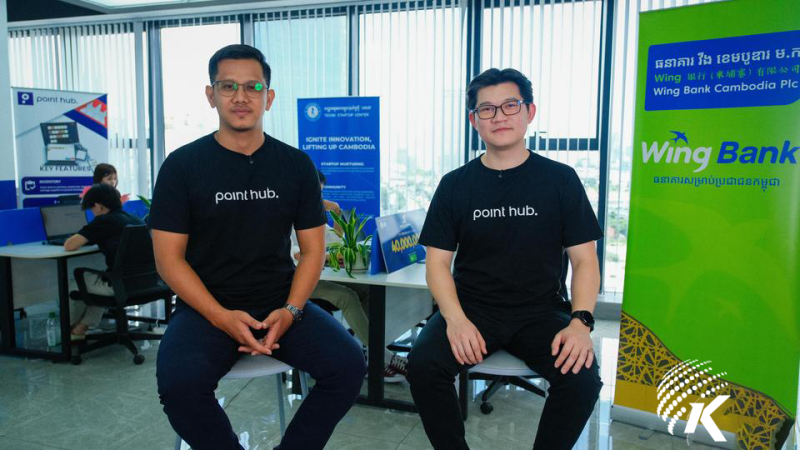
Driven by their shared passion for technology and leadership, Rat Mengheang and Heng Chinglong decided to create a special software tool, Point hub, which simplifies the business management of small- and medium-sized enterprises (SMEs) in Cambodia to drive the local economy.
Born in Kampong Thom province, Mengheang, 34, co-founder and CEO, initially pursued a Bachelor’s degree in Teaching English to Speakers of Other Languages (TESOL), and gained a second degree in computer science.
He worked for various companies after graduating from his degree for several years, but became stressed. This led Mengheang to start following his dream of starting his own business.
“I’m the oldest among my siblings so I [have this feeling] of wanting to lead. I had experienced working for other people during that time. It is stressful when we want to do something but don’t have the power to do it,” Mengheang said.
“Because we have more than seven years of experience, we learned about how to lead the team by ourselves. I asked myself, ‘Do we need to start our own business?’ The answer was yes, so we decided to start.”
Chinglong had a similar story. The 28-year-old co-founder and Business Development Manager at Point hub, was born in Phnom Penh and studied his Bachelor’s degree in business in Singapore. He then left for Australia to study IT, returning home with another Bachelor’s degree.
“When we learn, we know only the basics but what I needed was hard skills, so I returned to study again, this time to major in IT in Australia,” he shared, adding that having gained skills in coding and with a passion in technology, he was keen to start his own venture.
“At first, I wanted to start my life there [in Australia], but after some time I felt discontent. I knew a few family members and friends in Cambodia had gone home and opened their own business,” he said.
“So, I started thinking while I was there that I should learn something related to technology and develop it in our country. With my family’s support, I knew I could start it.”
Point hub Built for SMEs, Powered by Grit
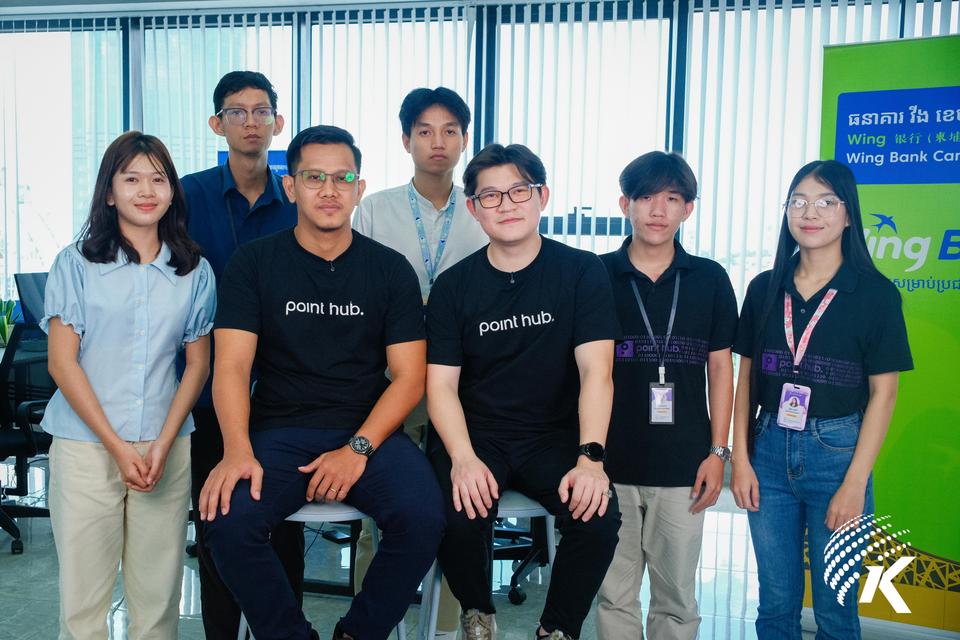
Point Hub is a simplified sales, inventory and membership management tool that helps businesses to grow. It can be installed on both mobile phones and computers.
Mengheang and Chinglong met at an event and became fast friends due to their shared interest. After experiencing similar issues at work, they decided to come together to develop the app through a start-up, which paved the way for the launch of Point hub in 2020.
One reason they started the business was because they observed that there are many technology companies that have invested their cash, but large markets usually do not fulfill the needs of small businesses. They wanted their start-up to play a critical role in bridging that gap.
However, they faced challenges in the beginning as they lacked marketing skills, only possessing work and tech skills.
“When we first started it was so hard as nobody knew or trusted us. We even boosted our pages [for our product] to gain attention, but it seemed like nobody needed it,” Chinglong mentioned.
The tech industry is wide, therefore, to succeed, he said it required the help of those involved in the sector to reach the right people. Chinglong said that at first, it was difficult convincing people to use their programme.
“So, we needed to know our business well and be patient. We had to make sure how much to produce, what to provide people and how to do it,” Chinglong said.
At first, they had no office or time to rest, not even on weekends, working hard to push their product. Chinglong recalled in the early days, people often asked, ‘Who are you?’, ‘How long have you been in business?’, ‘If I buy your product, and you close down the business, where do I go?’
“We lost more customers because we didn’t have an office, so customers did not trust us,” he added.
Mengheang said two years after they started the business, they felt like giving up as it required a lot of effort and the income was low, adding that back then they started to think it would be easier working for other people.
“But we told ourselves that we shouldn’t throw it [the business] away. We had to remind ourselves how and why we started; why did we start if we were going to throw it away? So, we continued with the business,” he said.
“I’m so proud of the small team here. It’s not only work, we have provided the young generation with a career and skills. Even if they left, they would have acquired good skills for their future.”
Turning Point Sparked by a No-Brainer Decision
Their break came when the business was at a low point. Disappointing sales prompted them to look around for ways to improve. In April 2025, they stumbled across the Digital Platform Accelerator (DPA) founded by Techo Start-Up Centre and supported by Wing Bank.
While they had a product they thought was ready for the market, they believed that the DPA programme would help them showcase their product while at the same time they could learn how to run a business.
“We could go to the market by ourselves or go to the Techo Start-Up Centre to join the programme. The decision was a no-brainer,” Chinglong said.
He explained that the Techo Start-Up is well-known among start-ups in Cambodia. The duo checked the centre’s previous activities and programmes and its impact on the ecosystem. “Trusting them and joining the programme was not a hard decision,” he said.
After they completed the DPA programme, their internal and external strategy completely changed for the better and sales improved.
“We learnt how to manage our human resources and finance and position our product to fit the needs of the market. We kept in touch with them and they continued to support us. We really appreciate the team and community for opening up many paths for our start-up,” Chlinglong said.
Three months of training with Techo Start-Up’s DPA rendered them technical business, management and operational skills.
“We have POS [point of sale] but we want to build one ecosystem where POS can connect to other businesses so that in the next 10 years, we have 20 to 30 staff to teach the younger generation to boost the local economy,” Mengheang said.
Point hub, was also selected as a top performer for demonstrating shared commitment to fostering Cambodia’s digital economy through innovation and entrepreneurship.
The start-up currently has about five staff, but Mengheang hopes that in 10 years it will grow to provide more opportunities for the younger generation who are passionate about technology.
Fueling Start-Up Growth Through Innovation
Sok Nam, Start-up Programme Manager at Techo Start-up Centre, said they are supporting the government’s vision by fostering start-ups, promoting digital business, and running flagship accelerator programmes, digital platform accelerators and reverse innovation, each with a distinctive model.
They also offer community programmes to support the start-up ecosystem and aspiring entrepreneurs, such as digital content programmes and hackathons.
“We typically engage with start-ups for three months with hands-on support. Our goal is to support start-ups in launching their products in the market as fast as possible. This is a key principle for start-ups to gain momentum and learn quickly,” Nam said.
After three months, assistance is offered based on their needs, with efforts to help start-ups explore regional markets through partnered programmes. That said, Nam said they face challenges, including funding as local funding is very limited and access to regional venture capital is hard to achieve due to the fairly nascent ecosystem.
“We have witnessed the rise in [some] fundings, namely the Entrepreneurial Development Fund, which recently announced a funding pool for tech start-ups. The start-ups tend to build the product for the local market, which is relatively small,” he said.
As of the end of 2024, the Techo start-up Centre has donated more than one billion riel in funding to 69 start-ups across eight branches. Among those, 64 percent are still active. Four alums have collaborated to start a new community called Chaktomuk Digital Hub, which is an initiative to support local start-ups.
The DPA is part of a long-standing partnership between Wing Bank and Techo Start-up Centre, which has spanned multiple impactful initiatives.
These include the Reverse Innovation Program (Cohorts 1–4), the Digital SME Accelerator (2021), Turing Hackathon, the Vietnam start-up Ecosystem Connectivity Visit (2024), and earlier cohorts of the Digital Platform Accelerator in 2022, 2023 and 2025. Collectively, these programmes have supported 160 start-ups and contributed to the creation of more than 2,000 jobs.
This article was originally reported by Kiripost. Read the full story here.


 Support