

 Exchange Rate
 Chat to Support

 ភាសាខ្មែរ


Although Cambodia is making notable progress in its green finance ecosystem, funding national climate goals to cut greenhouse gas emissions by 55 percent by 2035 will require $32 billion. However, experts are saying it is doable through green financing, with the NBC and financial institutions strengthening the frameworks.
Two products - green loans for solar and electric transport, and green bonds for large projects - have been introduced so far to fund the nation's energy revolution, though more needs to be done going forward.
Cambodia has set a monumental task to reduce its greenhouse gas emissions by 55 percent by 2035—an ambition that requires $32.2 billion to execute climate mitigation and adaptation. For starters, the financial sector has adopted green finance as a sustainable step to power environmental transformation.
Local banks have immersed themselves in the green energy revolution, offering green loans and strategic partnerships to make renewable energy accessible and affordable, according to a report by Cambodia Green, an environmental awareness platform.
There are two main types of green financial products in Cambodia, Sok Chan, Head of Financial Inclusion and Public Relations of the Association of Banks in Cambodia (ABC), said, noting that significant progress has been made to develop the green funding ecosystem.
He told Kiripost that institutions are enhancing their capacity and frameworks as green loans, such as renewable energy, energy efficiency, green buildings, clean transportation and sustainable agriculture, and green bonds, gradually emerge.
“These instruments are critical to provide financing to green projects across key sectors in Cambodia,” Chan said, however, adding that challenges remain, including a lack of commitment and requirement for the implementation of the Environmental, Social, and Governance (ESG) principles from shareholders, company directors and senior management.
At the same time, resources are low to establish and implement the policies, guidelines and tools relating to environment and social risk management, exclusion list, customer screening of Environment and Social practices, and sustainability disclosures. Additionally, he highlighted a lack of knowledge and capacity.
To move forward, the National Bank of Cambodia (NBC) is developing the Cambodia Sustainable Finance Taxonomy and Cambodia Sustainable Finance Roadmap, which serve as voluntary and essential frameworks to scale up green finance in the country.
In accordance with the Paris Agreement in 2015, which seeks to limit global temperature rise and combat climate change, Chan said green finance, referring to the funding of projects with positive environmental impacts, has emerged as a critical instrument to achieve global goals.
In Cambodia, green financing took shape shortly after, with increased attention from the government, financial institutions and development partners, Chan said.
Sustainable goal
Climate targets under the third Nationally Determined Contribution (NDC 3.0) by the National Council for Sustainable Development have been set to reduce greenhouse gas emissions by up to 55 percent by 2035. To achieve them, investments of $32.2 billion are required for mitigation, adaptation and enabling measures.
Aligning with clean energy commitment, the government’s Long-Term Strategy for Carbon Neutrality outlined in the EV Roadmap states that roads should feature 70 percent electric motorcycles and 40 percent of electric cars and urban buses to meet climate goals and reduce greenhouse gas emissions by 2050.
Reflecting this commitment, a recent report by the government showed that more than 10,000 electric vehicles (EVs) have been registered within nine months. Cambodia marked an important milestone in its transition to electric vehicles in September with the registration of 4,997 EVs, bringing the total this year to over 10,000.
The Ministry of Environment’s 2023-2028 Circular Strategy is focused on unlocking global climate cash by leveraging financial institutions and developing a strategy to mobilise green financing to support programmes and projects relating to the environment, climate change, biodiversity and sustainable development.
Regarding this, Chan said in 2016, the banking association introduced the Cambodia Sustainable Finance Initiative (CSFI), which aligns with UN sustainable development goals. This was followed by the creation of the Sustainable Finance Principles and its guidelines in 2019, encouraging banks to consider environmental and social factors in business decisions, including lending.
He said ABC promotes sustainable finance by tasking its Sustainable Finance Committee with monitoring ESG practices, developing key regulatory frameworks (Taxonomy Roadmap), and organising capacity-building training with partners, such as the International Finance Cooperation and Asian Development Bank.
“These sessions aim to build capacity, readiness and support the design of green financial products,” he said, noting that the members adopting CSFP increased from 48 to 74 members in 2024, including 57 commercial banks, eight specialised banks, six representative offices and two associations.
Clean energy business model
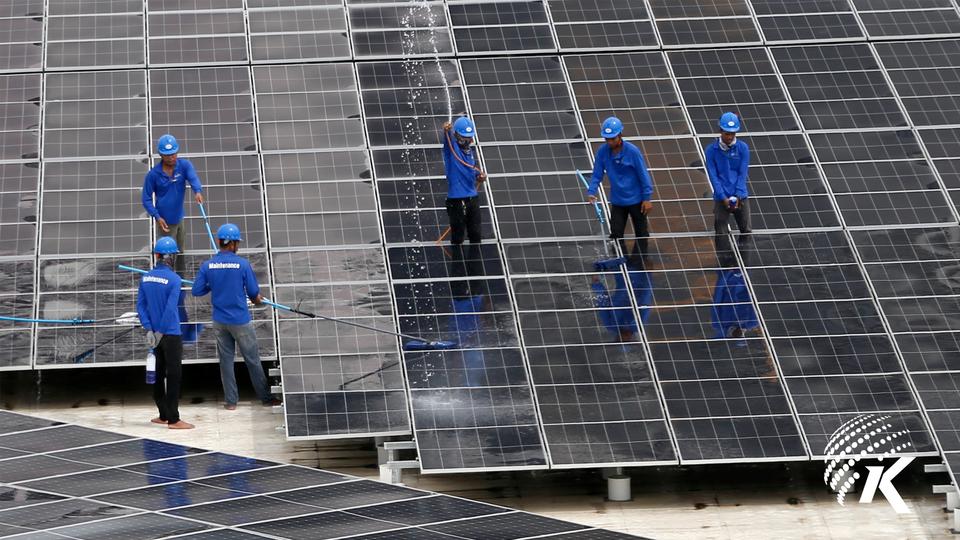
EGE Cambodia, one of the leaders in solar energy, delivers cost-effective solutions to reduce carbon emissions and empower communities across the country. Its Founder and CEO Vorn Chanraksmey told Kiripost that green loans for environmentally positive projects, like solar power, are new.
However, there is a developing trend in Cambodia, as banks slowly shift their lending to match broader sustainability and climate objectives.
“At EGE Cambodia, we have actively engaged with local financial institutions to explore financing options to expand our solar and clean-energy projects. While not all the loans we accessed were formally categorised as [green loans], the funding has been directed toward renewable-energy infrastructure, which directly supports the green-finance ecosystem.
“In this sense, we consider [ourselves] as part of the growing movement of businesses applying green financing in practice. We have also collaborated with various financial institutions, including Wing Bank, to advance clean-energy access and sustainable development in Cambodia,” Chanraksmey said.
Sharing that access to financing is crucial to accelerate clean-energy transition, she highlighted that many small- and medium-sized enterprises (SMEs) have innovative ideas and strong motivation to invest in renewable energy, but often lack sufficient capital to scale up. Green loans can bridge this gap by offering favourable terms such as lower interest rates, longer repayment periods, or complementary technical support.
“Thus, encouraging businesses to utilise green financing not only enables sustainable growth but also strengthens Cambodia’s energy independence, resilience, and competitiveness in the regional renewable-energy landscape,” she said.
Every investment in clean energy, whether through solar installations, energy-efficiency upgrades, or waste-to-energy systems plays a vital role in expanding the sector, building public confidence, and demonstrating that green projects can be both environmentally and economically sustainable.
“When businesses successfully implement such projects through green financing, they become influential role models, inspiring others and creating a ripple effect that accelerates innovation, job creation, and broader adoption of renewable solutions across Cambodia,” she remarked.
Civil society participation
Soeung Saroeun, Executive Director of NGO Forum on Cambodia, which works on climate resilience and natural resource governance, viewed that green financing in Cambodia is gaining momentum.
The alignment between the NBC’s Sustainable Finance Principles and the ASEAN Green Taxonomy is an important step forward. Financial institutions are beginning to see that sustainability is not only about corporate responsibility but also about financial resilience and competitiveness.
When asked how his organisation helps to promote, access and qualify for green loans, Saroeun said they ensure that green finance reaches those most affected by climate and environmental problems.
The organisation also collaborates with the government, NBC, ABC, civil society organisations (CSOs), community-based organisations and cooperatives to improve people’s financial literacy, documentation, and readiness for small-scale green investments, such as household solar systems, clean stoves, and water-efficient farming tools.
“We also engage in policy dialogue with the NBC and microfinance institutions to make loan products more inclusive, by adjusting collateral requirements, improving transparency on interest rates, and integrating ESG safeguards. We aim to make [green] not just a colour for finance, but a pathway for inclusion, empowerment, and sustainability,” Saroeun said.
Wing Bank’s financing for climate-smart agriculture
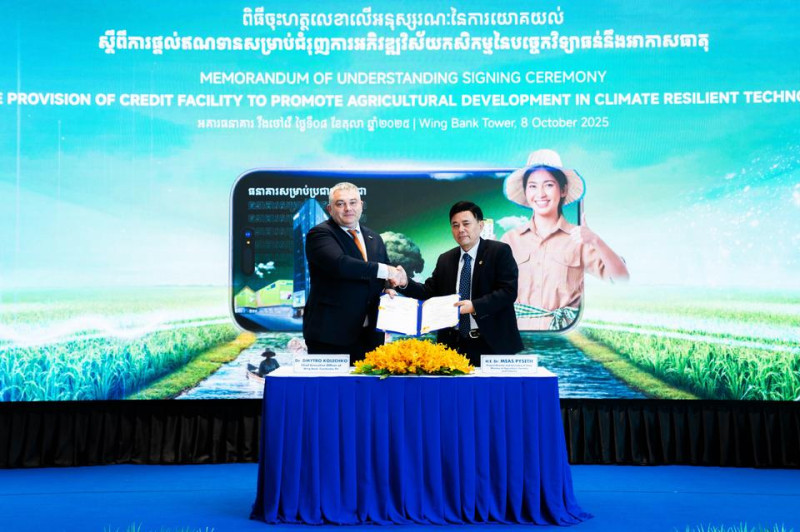
In October, the Wing Bank and Project Support Unit under the Ministry of Agriculture, Forestry and Fisheries launched a new financing initiative to empower agricultural communities in Battambang, Kampong Chhnang, Kampong Thom, Prey Veng, and Takeo to invest in climate-smart technologies.
The bank committed $3 million as loans and without collateral or approval fees required at a competitive interest rate of 8.5 percent per annum and repayment terms of up to 42 months.
“As climate change is a global challenge of our time, we must equip our communities with the tools and technologies to grow sustainably, safeguard their livelihoods, and build lasting resilience,” said Dr. Dmytro Kolechko, CEO of Wing Bank, at the launch.
Eligible applicants can access loans of up to $200,000 to finance innovative solutions such as solar-powered irrigation systems, net houses, efficient water management systems, renewable energy applications, and modern farming practices. These technologies are designed to help farmers adapt to increasingly unpredictable weather conditions, improve agricultural productivity, and secure more stable incomes for their families and communities.
Farmers and agribusiness owners interested in applying for financial assistance can contact the Project Support Unit, visit any Wing Bank branch, or reach out via Wing Bank’s official Facebook page: WingBankKH, for more information.
Learning to be green, including finance
The market is still small, Saroeun observed, so access is limited to clients, and many commercial banks focus on large-scale renewable energy or real estate projects rather than community-based or household-level initiatives.
There is a need for stronger incentives, clearer standards, and public–private collaboration to expand green finance beyond the urban and corporate sectors, he said, adding that Cambodia can learn valuable lessons from the region.
He pointed out that Malaysia showed the importance of government-backed green bond frameworks and credit guarantees that de-risk private investments, while Indonesia demonstrated how digital finance can link smallholders with affordable green credit through fintech platforms.
Closer to home, Vietnam highlighted the role of strong coordination between central banks and line ministries in enforcing green lending guidelines. The key takeaway, he said, is that scaling green finance requires an integrated ecosystem, with regulators, banks, civil society, and local communities working together to ensure environmental and social impact, not just financial returns.
In a statement to Kiripost, EnergyLab Asia said access to capital is a significant barrier to investment in any new technology or infrastructure at scale, particularly green investments. About $11 billion is needed for Cambodia's energy transition.
While green finance is not yet a mainstream concept in Cambodia, the situation is changing quickly as it is a frontrunner in the development of carbon markets, it said, citing examples of consumer-oriented green loans by multilateral institutions and large concessional finance by the Green Climate Fund.
“There is an increasing interest from the market to adopt green financial products. But we need to make it easier to access these products, as processes are currently too long and complex. We also need to reduce the cost of adoption.”
EnergyLab Asia pointed out that green loans have a measurable environmental impact, noting that financial institutions can assess prospective green loans against qualification criteria. “These need to be robust to avoid green washing.”
It added that for green loans to be successful, the government has a number of ambitious targets for clean energy adoption, energy efficiency improvements, and increased adoption of electric vehicles.


 Support