

 Exchange Rate
 Chat to Support

 ភាសាខ្មែរ



Cambodia faces rapid economic development and digital transformation, educating students on how to handle finances has become more crucial to ensuring they are well-prepared for future challenges and opportunities.
In recent years, Cambodian schools have introduced financial literacy as part of their education programme, helping students gain a deeper understanding of managing money, savings, and investing for the future.
This shift in education is already motivating students to take practical steps toward securing their financial future, such as opening bank accounts and setting aside money for long-term goals like college and investment. It is also encouraging the rise of a financially-savvy generation.
Ieng Areyeak and Ly Meyjing, both eighth-graders at AUPP Liger Leadership Academy, a private secondary school in Cambodia, were introduced to AUPP’s standalone financial literacy curriculum called “Money Tree” in the seventh grade.
The programme, available in Khmer and English, is taught for a year as part of AUPP’s project-based learning for grade seven students. They gained a deeper understanding of global and Cambodian economies, including trade, tariffs, financial institutions, stock market and even the World Trade Organisation.
“We first learned how to manage our money, then we went deeper. We got to know about investments, how banks work as well as about taxes,” Meyjing said.
Although she was aware of the importance of saving, her financial literacy was so limited that she did not know the procedure.
“Should we save money in a piggy bank or a bank; where can we put our money to gain interest?” she wondered before learning about financial literacy. She said there are several types of bank accounts where people can save money, including fixed deposits.
Being part of the course helped broaden Meyjing's understanding of the simple concepts she was already familiar with.
Similarly, Areyeak had little prior exposure to financial literacy, initially believing it was just about saving, the economy, and finance. After a year of study, his experience and perspective on the topic expanded.
“It helped me learn about the different types of bank accounts, the effects of banks and organisations on the economy, and the role of the government in an economy,” he said.
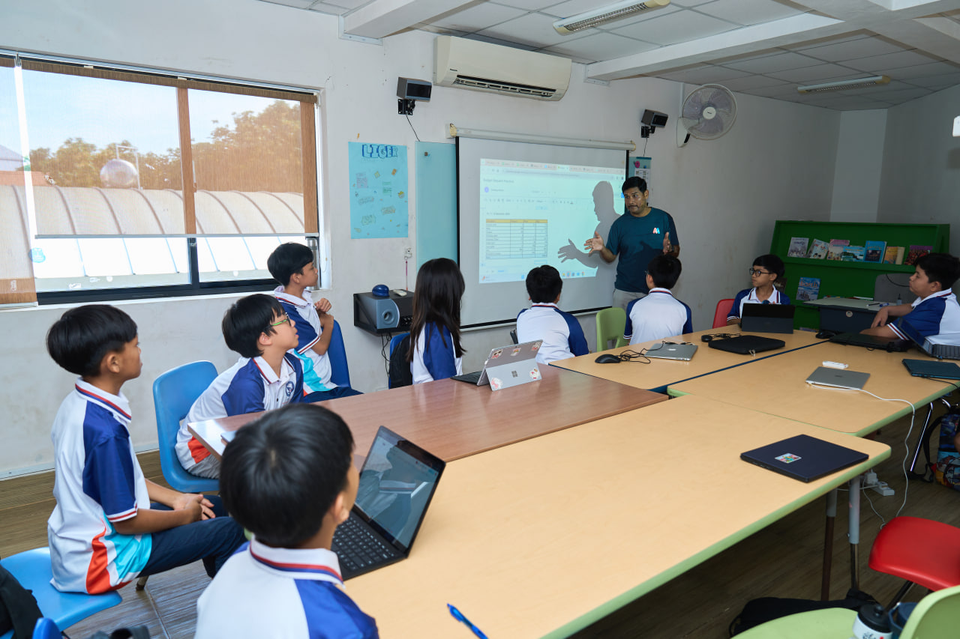
Saving for college and investment
Having learnt about financial literacy, the students ask their parents to open bank accounts for them, so they could save for their future.
Recently, the Ministry of Education, Youth, and Sport encouraged university students to participate in National Bank of Cambodia (NBC)’s pilot “Bakong Junior” payment system. The initiative aimed to inculcate the habit of saving, budgeting and efficient financial planning.
Students can register to use the app which offers secure digital payment features and financial education tools.
“I managed to get my parents’ permission to open a fixed deposit account to save any money I get so as to invest in my future and support my college education,” Areyeak said.
Like him, Meyjing also asked her parents to open a savings account for her. As she is currently boarded at AUPP Liger Leadership Academy, the financial knowledge she gained helped her manage the allowance her parents give.
“I was able to manage my allowance and even save some by the end of the term,” she said.
Sok Chan, Financial Inclusion Head of the Association of Banks in Cambodia (ABC), noted that financial literacy helps children adopt and prudently manage digital financial services.
“Educating Cambodian children and youth about managing money and knowing financial consumer rights and responsibilities from a young age help them build smart money skills for their future,” he said. “They can also share this knowledge with their families.”
According to the NBC, banking and financial institution assets rose 7.3 percent to $97.1 billion in the first half of 2025. “Customer deposits also grew by 14.5 percent to $61.5 billion, with the number of deposit accounts reaching 28.2 million, while credit accounts rose to 4.3 million”.
This growth in deposit accounts shows that more individuals are developing saving habits and understanding secure money management.
Exposing the young to money matters
Areyeak believed that early exposure to financial literacy was crucial as the practice would be much simpler when they are older.
“For example, you can open a bank account, save money, and also invest in the stock market if you already know about it. Your money will grow in the account, and also protect you during an economic downturn,” he said.
Meyjing said gaining financial literacy at a young age allows them to start saving early and managing their money effectively when they start working one day.
“If you want to start a business in the future and you’ve learned about finance since young, you could start saving and ask your parents to open a fixed deposit account for you. So, you can use that money to open a business or for college in future,” she said.
Cambodia has a financial literacy rate of 18 percent, ranking 135 out of 144 countries, according to the Global Financial Literacy Report 2015. Its overall financial literacy score is 11.5, placing it at the low end of 30 countries, according to Asian Development Bank’s report “Determinants and Impacts of Financial Literacy in Cambodia and Vietnam”.

Empowering Youth for a Smarter Financial Future
In an era of rapid digital transformation, financial literacy has become a cornerstone for youth empowerment in Cambodia. With mobile payments, online banking, and investment platforms reshaping the financial landscape, young people need more than access—they need knowledge.
“Our youth are entering a world of digital payments, credit, and investment opportunities. Without the right knowledge, they risk falling into debt or missing chances to build wealth,” said Bunthe Hor, Deputy CEO of Wing Bank.
The bank partnered with Kot Luy to launch the “Youth & Money” initiative in October 2024. The program aims to reach over 5,000 students from TVET institutions and universities across eight provinces, equipping them with essential financial skills to thrive in an increasingly digital economy.
“By empowering young Cambodians with practical financial skills—budgeting, saving, and planning for the future—we are not just shaping responsible individuals; we are investing in the nation’s economic resilience and growth,” Bunthe Hor added.
As part of its commitment to financial empowerment, Wing Bank introduced the Save for Goal account, designed to help users achieve their financial objectives gradually while earning interest to grow their wealth.
“Saving is important at every stage of life. For youth, it helps them plan, stay disciplined, and achieve their goals,” Bunthe Hor added. “That’s why we created Save for Goal—to make saving simple, rewarding, and accessible.”
The Save for Goal account allows individuals to create personal or joint savings accounts, with the flexibility to add funds anytime—daily or monthly. Customers can earn an interest rate of up to 5% per annum, helping them reach their financial goals faster.
“A simple way for young people to build a strong financial future is to start by creating a clear budget, saving before spending, understanding how credit works, using digital banking tools responsibly, and setting achievable financial goals. These habits will help them gain confidence, independence, and long-term success,” Bunthe Hor added.
Financial literacy for all
On February 1, 2024, Yim Leat, NBC deputy governor, and Kim Sethany, Secretary of the Ministry of Education, Youth and Sports, signed a Memorandum of Understanding to set up the Project on Embedding Financial Literacy into School Curriculum-Phase 3.
The project, which runs from 2024 to 2026, and implemented in grades 5 to 12, enables students to understand concepts related to savings, lending and financial management by integrating topics within core subjects, including mathematics, morality-civics and life skills.
NBC Governor Chea Serey has previously said that incorporating financial literacy in the educational system cultivates a sense of responsibility, thoughtfulness, and problem-solving abilities, stressing that it provides an edge to people's achievement.
“The embedding of financial literacy is a long-term investment since it not only assists individuals in making the right decision in finance, but also contributes to the welfare and stability of our society,” she said.
NBC promotes financial literacy through its National Financial Inclusion Strategy 2019-2025 by partnering with ABC, Cambodia Microfinance Association (CMA), and other development groups.
The programmes include Let's Talk Money, Financial Street, Promoting Financial Literacy for Women and Women Entrepreneurs, Banking Sector Programme for Economic Literacy, and financial literacy in school curriculum.
This article was originally reported by Kiripost. Read the full story here.

 Support